
Senior Care Advice
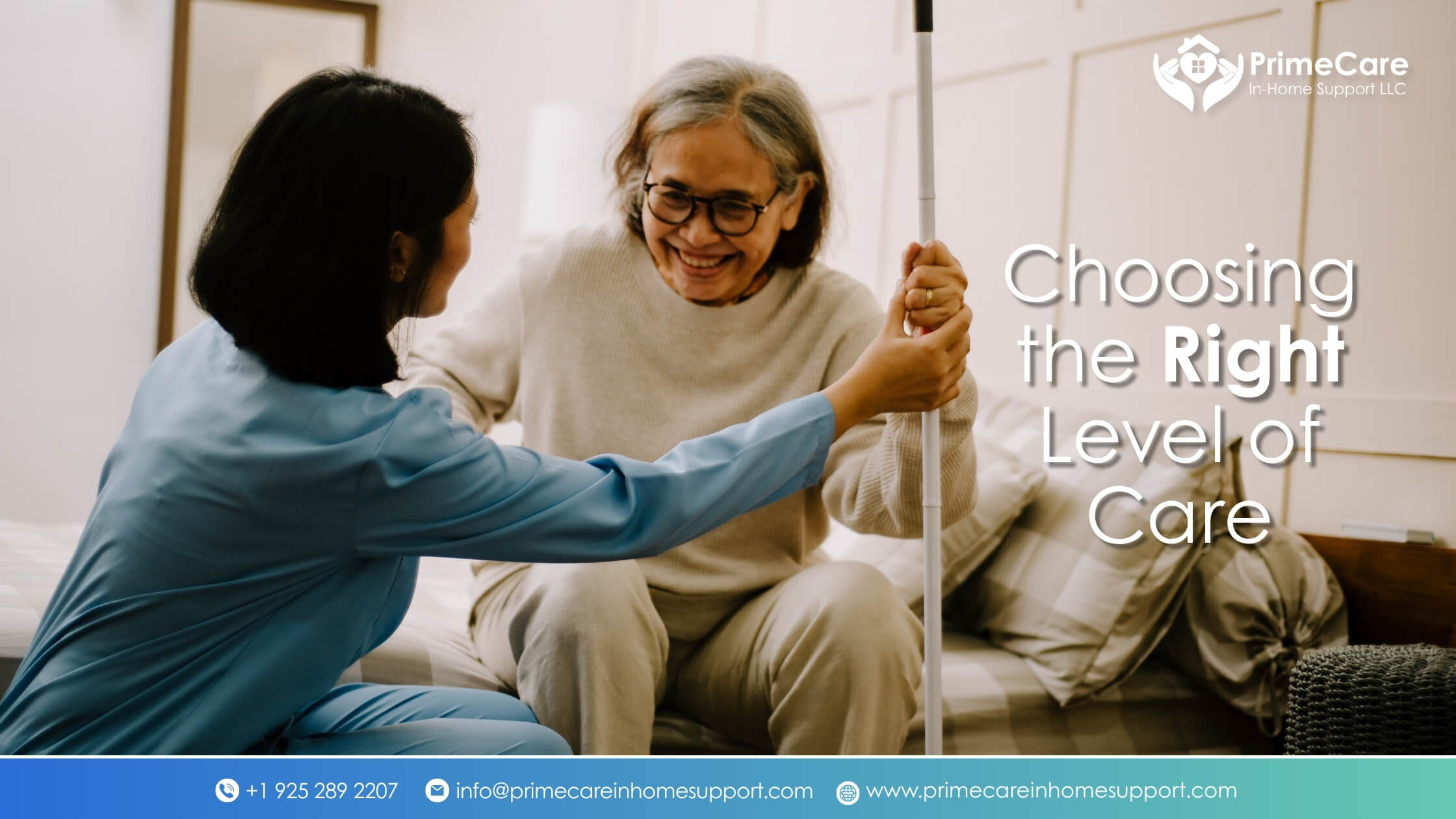
Choosing the Right Level of Care: A Simple Framework for Families
Every family’s care journey starts the same way, with a question that feels impossible to answer: “How much help does my loved one actually need?”
The Four Levels, at a Glance
- Companion Care — a few hours a week
- Part-Time Personal Care — several hours a day
- Full-Time or Extended Care — 8+ hours a day
- Round-the-Clock Care — 24/7 coverage
Home care isn’t one-size-fits-all. It exists on a spectrum, from a few hours of friendly companionship each week to round-the-clock support for someone with complex needs. The right level of care depends on where your loved one is today, and it can, and often should, change over time.
At PrimeCare In-Home Support, we work with families across Alameda, Contra Costa, San Mateo, San Francisco, and Santa Clara counties every day to figure this out together. Here’s the framework we use to help take the guesswork out of it.
What Does a Typical Day Look Like?
Before thinking about hours or schedules, walk through your loved one’s day from morning to night. Ask:
- Are they getting up, dressed, and fed safely and consistently?
- Are they managing medications correctly?
- Are they isolated, or do they have regular social contact?
- Has there been a recent fall, hospitalization, or diagnosis?
- Are family caregivers feeling stretched thin or burned out?
The answers to these questions naturally point toward one of a few general levels of care.
The Four Levels of Care
Companion Care
Best for: loved ones who are largely independent but could use company, conversation, transportation, or light help around the house.
This level focuses on quality of life, reducing isolation, running errands, accompanying them to appointments, and giving family members peace of mind. It’s often the right starting point for someone aging in place but showing early signs of needing a bit more support.
Part-Time Personal Care
Best for: loved ones who need hands-on help with daily activities like bathing, dressing, grooming, or meal preparation, but who don’t require supervision around the clock.
A caregiver typically comes in during key parts of the day — mornings and evenings, for example — to help with routines that have become harder to manage alone.
Full-Time or Extended Care
Best for: loved ones with a chronic condition, mobility limitations, or memory changes that make it unsafe to be alone for long stretches.
This level often includes help with mobility, medication reminders, meal planning, light housekeeping, and consistent supervision — while still allowing your loved one to remain in the comfort of their own home rather than transitioning to a facility.
Round-the-Clock (24/7) Care
Best for: loved ones with advanced needs, significant cognitive decline, high fall risk, or medical complexity, who require support and supervision at all hours, including overnight.
24/7 care can be provided through live-in caregivers or rotating shifts, ensuring someone is always present and alert. This is often the level families turn to when safety, rather than just comfort, becomes the primary concern.
It’s Not Always a Straight Line
One of the most important things to understand is that care needs rarely stay static. A parent might start with a few hours of companion care and, over a year or two, gradually need more support after a fall or a change in health. Others may need intensive care temporarily, say, after surgery, and step back down once they’ve recovered.
You shouldn’t have to switch agencies every time your loved one’s needs shift.
This is why flexibility matters as much as the care itself.
How PrimeCare In-Home Support Helps Families Decide
Every family we work with gets a personalized in-home assessment before we recommend a care plan. Rather than fitting your loved one into a fixed package, we build a plan around their actual daily life, and adjust it as circumstances change — whether that means scaling up support after a health event or scaling back as they regain independence.
Our caregivers provide the full range of non-medical home care, from a few hours of weekly companionship to full-time and round-the-clock support, throughout the Bay Area.
Not Sure Which Level Is Right?
That’s exactly what we’re here to help you figure out. We’ll walk through your loved one’s needs together and recommend a starting point that makes sense for your family.
Contact Us
Contact PrimeCare In-Home Support to learn more about our personalized non-medical in-home care services.