
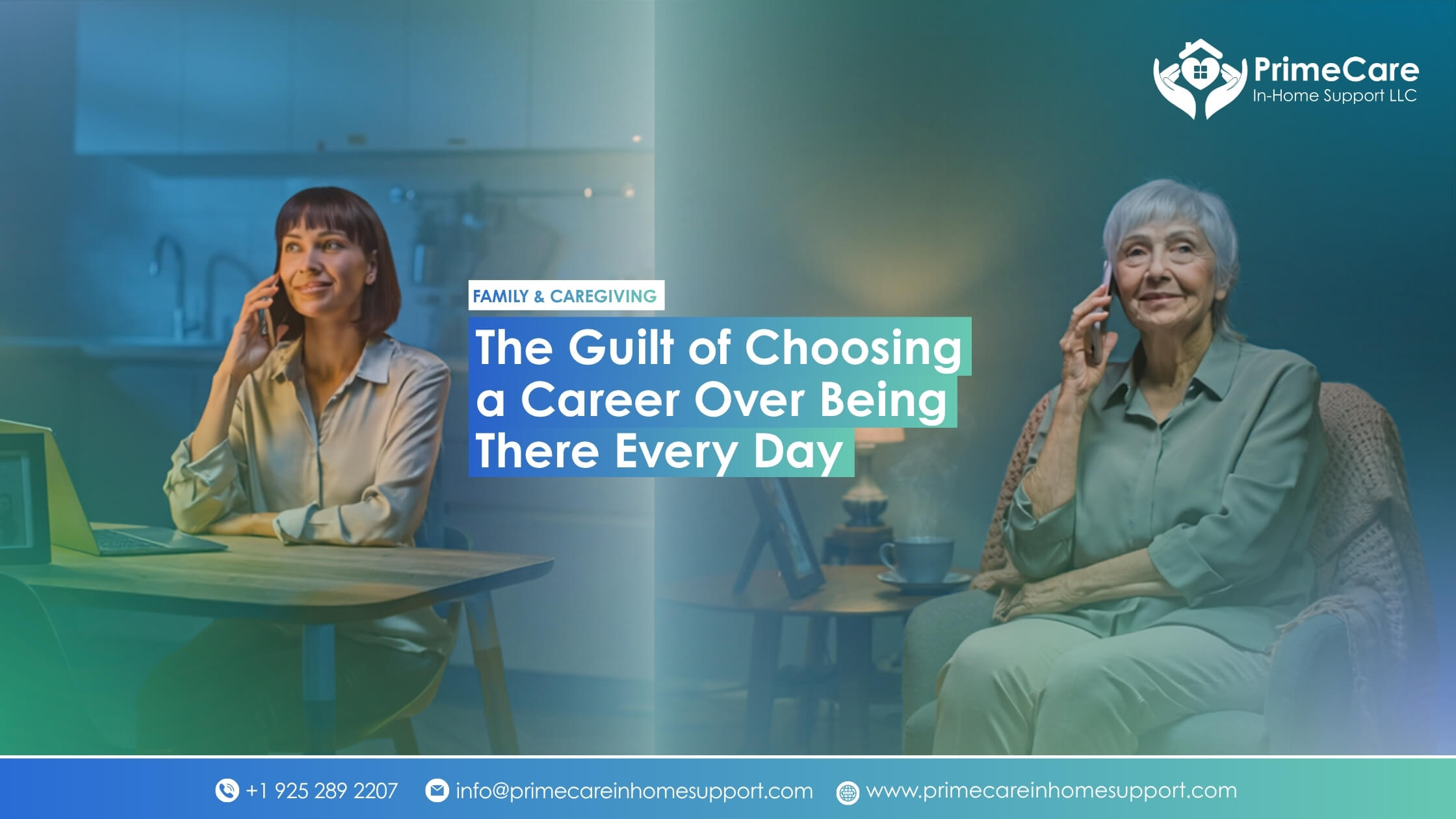
Family & Caregiving
The Guilt of Choosing a Career Over Being There Every Day
You built a career, a home, maybe a family of your own — often somewhere other than where you grew up. Now a parent is aging, and a quiet voice keeps asking if you made the wrong choice. You didn’t. But the guilt doesn’t always listen to logic.
Quick Takeaways
- Guilt over distance or career is one of the most common, least talked-about caregiving struggles
- Comparing yourself to a sibling who “does more” rarely accounts for the full picture
- Showing up consistently can look different than daily hands-on care and still count
- Professional in-home care can be what makes your version of showing up actually work
It usually creeps in during ordinary moments. You’re at your desk, in a meeting, or putting your own kids to bed, and a thought slides in sideways: my mother is alone right now, and I’m not there. It doesn’t matter that you have a mortgage in another city, a job that supports your family, or a life you worked hard to build. In that moment, none of that feels like a good enough reason.
This is one of the quieter struggles of having an aging parent — not the logistics of care, but the guilt of not being the one providing it day to day.
Why This Guilt Runs So Deep
Part of it comes from an image many of us grew up with — that “good” adult children live nearby, drop by often, and handle things personally when a parent needs help. When your actual life doesn’t match that picture, it’s easy to interpret the gap as a personal failing rather than a normal outcome of building an independent adult life.
It’s also common to compare yourself to a sibling who lives closer, and to quietly assume they’re doing more, handling more, sacrificing more. Sometimes that’s true. But it’s also common for the sibling who’s physically present to feel just as stretched, and for the sibling who’s far away to be contributing in ways that don’t show up as visibly — financially, logistically, or by being the one who researches options and coordinates care from a distance.
Distance changes what caregiving looks like. It doesn’t erase it.
What Showing Up Can Actually Look Like
Caregiving from a distance rarely looks like the version people picture. It often looks more like:
- Being the one who researches care options, insurance questions, and next steps
- Calling regularly, not just when something’s wrong
- Flying or driving in for the appointments and decisions that matter most, even if it can’t be every day
- Contributing financially toward the support a parent needs
- Coordinating with siblings, doctors, or a care agency so nothing falls through the cracks
None of this looks like the daily, hands-on image of caregiving most of us picture. But it’s still real involvement, and it still matters to the outcome, even when it doesn’t feel like enough from where you’re standing.
Where Professional Care Fits Into the Guilt
One of the hardest parts of this guilt is the fear that bringing in outside help means admitting defeat — that a “real” family would handle it themselves. In practice, it’s closer to the opposite. Hiring in-home care isn’t replacing your role. It’s what allows your parent to be safe and supported on the days you genuinely cannot be there, which is most days, if you live somewhere else.
A caregiver who shows up consistently, notices small changes, and reports back to you gives you something guilt alone never can: an actual, reliable way to stay involved in your parent’s daily life, even from a distance. It doesn’t erase the wish that you could be there in person. But it does close the gap between wanting to help and actually being able to.
PrimeCare In-Home Support works with a number of adult children who live outside the Bay Area, or who simply can’t be there as often as they’d like. Regular updates and consistent caregiver matching mean you’re not left wondering how your parent’s day actually went.
Can’t be there as often as you’d like?
A free in-home assessment can help you find a way to stay involved, even from a distance.
Frequently Asked Questions
Is it normal to feel guilty about not being able to care for a parent in person?
Yes. It’s one of the most common feelings among adult children who live far from an aging parent or have demanding careers. Guilt doesn’t necessarily reflect how much you’re actually contributing.
Does hiring a caregiver mean I’m not doing enough for my parent?
No. Professional in-home care is what makes it possible for your parent to be supported on the days you can’t be there in person — it’s a way of staying involved, not stepping away.
How can I stay involved in my parent’s care from a distance?
Regular updates from a caregiver, staying in contact with siblings or other family, and choosing an agency that communicates consistently can help you stay meaningfully involved even when you can’t visit often.
Does PrimeCare provide updates to family members who live out of town?
Yes. PrimeCare In-Home Support keeps families informed and involved, so distance doesn’t mean losing touch with how your parent is actually doing.