
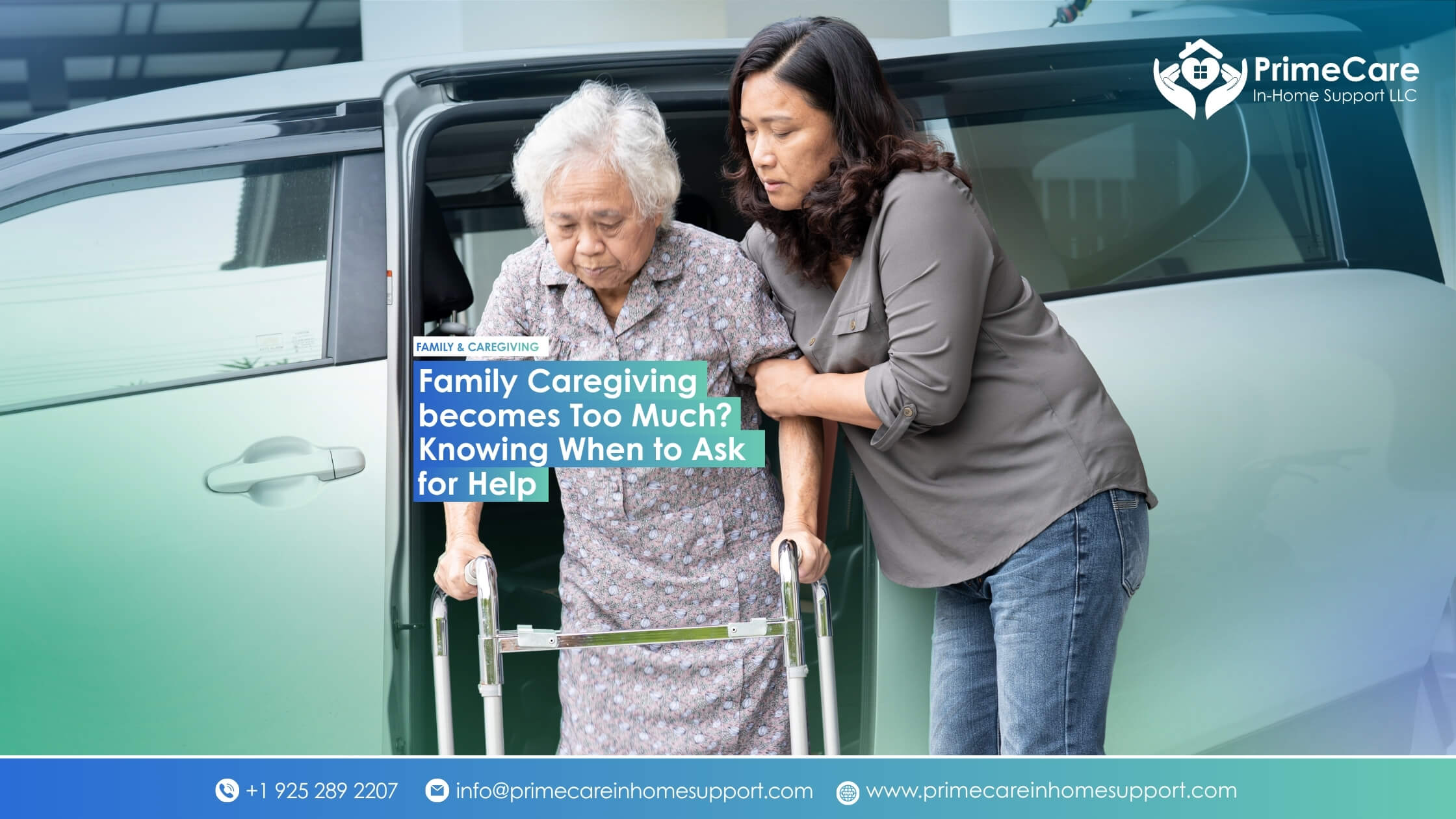
Family Caregivers Month · Caregiver Support
When Family Caregiving Becomes Too Much: Knowing When to Ask for Help
Caring for a parent or spouse is an act of love, and it can also become more than one person can carry. This guide helps you spot the signs that family caregiving has become too much, and shows practical ways to ask for help without guilt.
The short version
- Caregiving has likely become too much when exhaustion, health problems, or worry about safety start to build, not just on hard days.
- Asking for help is part of caring well. A caregiver who is rested and healthy can keep caring longer.
- Help can be small and specific: a sibling takes one afternoon, a neighbor helps with rides, or a home caregiver covers a few hours a week.
- Respite care gives you a scheduled break. It is common, and it does not mean you are giving up.
- PrimeCare offers non-medical home care with a free in-home assessment, flexible scheduling, and a 4-hour minimum shift.
It rarely happens all at once. First it is a few extra errands, then the pharmacy runs, the meals, the late-night phone calls. Months later you are answering work email from a waiting room, and you cannot remember the last time you slept through the night.
November is National Family Caregivers Month, led by the Caregiver Action Network, and the 2026 theme is “Care Connects Us.” It is a good time to say what is often left unsaid. According to AARP and the National Alliance for Caregiving, 63 million Americans, nearly 1 in 4 adults, provided ongoing care in 2025. Nearly 1 in 4 caregivers report feeling socially isolated, and reports of emotional stress have risen since 2020.
PrimeCare In-Home Support is a licensed, non-medical home care agency in San Leandro, CA. This guide is for the caregiver, not only the person receiving care. It is general information, not medical or mental health advice.
In this guide

Warning signs · Check in with yourself
Signs caregiving has become too much
Short answer: caregiving has become too much when your own health, mood, relationships, or work are suffering, or when you worry your loved one is not safe with the care you can give. One bad week is normal. A steady pattern is the signal.
In your body
- Constant tiredness, even after rest
- Getting sick more often, or skipping your own doctor visits
- Sleeping too little or too much, or changes in appetite
In your mind and mood
- Feeling irritable, tearful, or numb
- Dread when the phone rings, or resentment you then feel guilty about
- Feeling hopeless, or like there is no end in sight
In your daily life
- Pulling back from friends, hobbies, or faith community
- Missing work, falling behind, or worrying about money
- Close calls at home: falls, missed medications, wandering, or a loved one left alone longer than you are comfortable with
If you feel hopeless or have thoughts of harming yourself or someone else, call or text 988 (the Suicide and Crisis Lifeline) or call 911 in an emergency. For a deeper look at stress and exhaustion, read our guide to recognizing caregiver burnout.
Gut check · Your limit
Five questions to find your limit
Short answer: if you answer “no” to the first two questions or “yes” to any of the last three, it is time to add help. This is a simple gut check, not a diagnosis.
- Can I keep up this pace for another six months?
- Is my loved one safe and well cared for when I am not there?
- Have my own health, job, or relationships started to suffer?
- Are their needs growing beyond what I can do, such as lifting, nights, or wandering?
- Do I dread the day more than I look forward to time together?
Needs grow gradually, so it can help to name them. Our signs your aging parent may need in-home care and framework for choosing the right level of care can help you see where things stand.
Mindset · The guilt
Why asking for help feels so hard
Short answer: most caregivers feel they should be able to do it all, and that asking for help means failing. It does not. Needing support is a sign of how much you are carrying, not how much you care.
Try to avoid
“I should be able to handle this myself.”
Try instead
“Getting help is how I keep caring for them.”
Many people also worry about how their parent will react, or about cost. Both are fair concerns, and both are easier to handle when you start before a crisis.
Try to avoid
“I’m fine. Don’t worry about me.”
Try instead
“Could you take Tuesday afternoons, so I can rest?”
Specific requests work better than general ones. For help starting the conversation with a parent, read how to talk to your parents about home care.
Support · Where help comes from
Your options for getting help
Short answer: most families combine several kinds of help: other family, community programs, respite, time off work, and paid home care. You do not have to pick only one.
- Family and friends: give each person one clear task, such as groceries, a weekly call, or a ride to appointments.
- Community programs: the Eldercare Locator (1-800-677-1116) connects older adults and families to local aging services, and the Family Caregiver Alliance offers caregiver education and support.
- Respite care: short-term care so you can rest, attend your own appointments, or travel. PrimeCare respite care provides this at home.
- Time off work: California Paid Family Leave provides up to 8 weeks of wage replacement in a 12-month period to care for a seriously ill family member. It does not include job protection, so check eligibility and your employer’s policies.
- Paid home care: a caregiver who comes on a regular schedule and takes on tasks you cannot or should not do alone.
Home care · What changes
What home care can take off your plate
Short answer: a home caregiver can handle everyday support, such as personal care, meals, light housekeeping, rides, and companionship, so you can go back to being a daughter, son, or spouse. It is non-medical, and the care plan adjusts as needs change.
- Personal care: bathing, dressing, grooming, and mobility help
- Meals, laundry, light housekeeping, and medication reminders
- Rides to appointments and outings
- Companionship and a friendly presence, so your loved one is not alone
- Overnight or longer shifts when nights are the hardest part
Our caregivers support your loved one’s routine and the doctor’s plan. They do not provide:
- Nursing care or medical treatment
- Administering medications, as opposed to reminding
- Diagnosing conditions or changing a care plan
Many families start small, with a few hours a week, and add more only if and when it feels right. PrimeCare offers flexible scheduling with a 4-hour minimum shift. Medicare generally does not pay for non-medical home care, so see the cost of home care to plan. If you are comparing agencies, use our questions to ask before choosing a home care agency.
Next steps · Getting started
How to get started
Short answer: call or request a free in-home assessment. We meet you and your loved one at home, learn their routine, and build a personalized care plan. There is no obligation to begin.
- Call or request a free assessment and tell us what is going on.
- Meet at home to talk through needs, routines, and your own limits.
- Receive a care plan and schedule that fits your family.
- Care begins with a matched caregiver, and the plan adjusts as needs change.
A written care plan also makes sharing the load easier. See care plan organization for a simple way to keep everyone on the same page.
Frequently asked questions
What is National Family Caregivers Month?
National Family Caregivers Month is observed each November to recognize and honor family caregivers. It is led by the Caregiver Action Network, and the 2026 theme is “Care Connects Us.”
How do I know if family caregiving has become too much?
Warning signs include constant exhaustion, getting sick often, mood changes, pulling away from friends, trouble at work, and worry that your loved one is not safe. A steady pattern, not one hard week, is the signal to add help.
Is it normal to feel guilty about needing help?
Yes. Many family caregivers feel guilty or think they should handle everything alone. Asking for help is a way to keep caring well, and it protects your own health.
What is respite care?
Respite care is short-term care that gives a family caregiver a break. It can be a few hours a week or longer, and it can be provided at home by a caregiver while you rest, work, or attend your own appointments.
How can home care help a family caregiver?
A home caregiver can help with personal care, meals, light housekeeping, rides, companionship, and medication reminders, so you can rest and focus on your relationship. Home care is non-medical and follows the doctor’s plan.
Does Medicare pay for home care or respite?
Medicare generally does not pay for non-medical home care or long-term help with daily living. It may cover limited short-term respite in specific situations, such as under the hospice benefit. Confirm what applies with Medicare or your insurer.
Can I get paid time off to care for a family member in California?
California Paid Family Leave provides up to 8 weeks of wage replacement in a 12-month period to care for a seriously ill family member. It does not provide job protection, so check eligibility with the EDD and your employer.
How much help should I start with?
Many families start with a few hours a week and increase if needed. PrimeCare offers flexible scheduling with a 4-hour minimum shift, and the plan adjusts as needs change.
How do I get started with PrimeCare?
Call PrimeCare or request a free assessment. We visit your loved one at home, learn their needs and routine, and build a personalized care plan with no obligation.
You don’t have to carry this alone. Let’s talk.
Free, no-obligation in-home assessment, personalized to your family’s needs. Serving families across Alameda, Contra Costa, Santa Clara, San Mateo, and San Francisco counties.
This article is for general information and is not medical, mental health, legal, or financial advice. Caregiving statistics come from AARP and the National Alliance for Caregiving, Caregiving in the U.S. 2025. Paid Family Leave details come from the California Employment Development Department and may change. PrimeCare In-Home Support LLC is a licensed home care organization (HCO #014700283) providing non-medical care, located at 433 Callan Ave STE 203, San Leandro, CA. If you or someone you know is in crisis, call or text 988 or call 911 in an emergency.